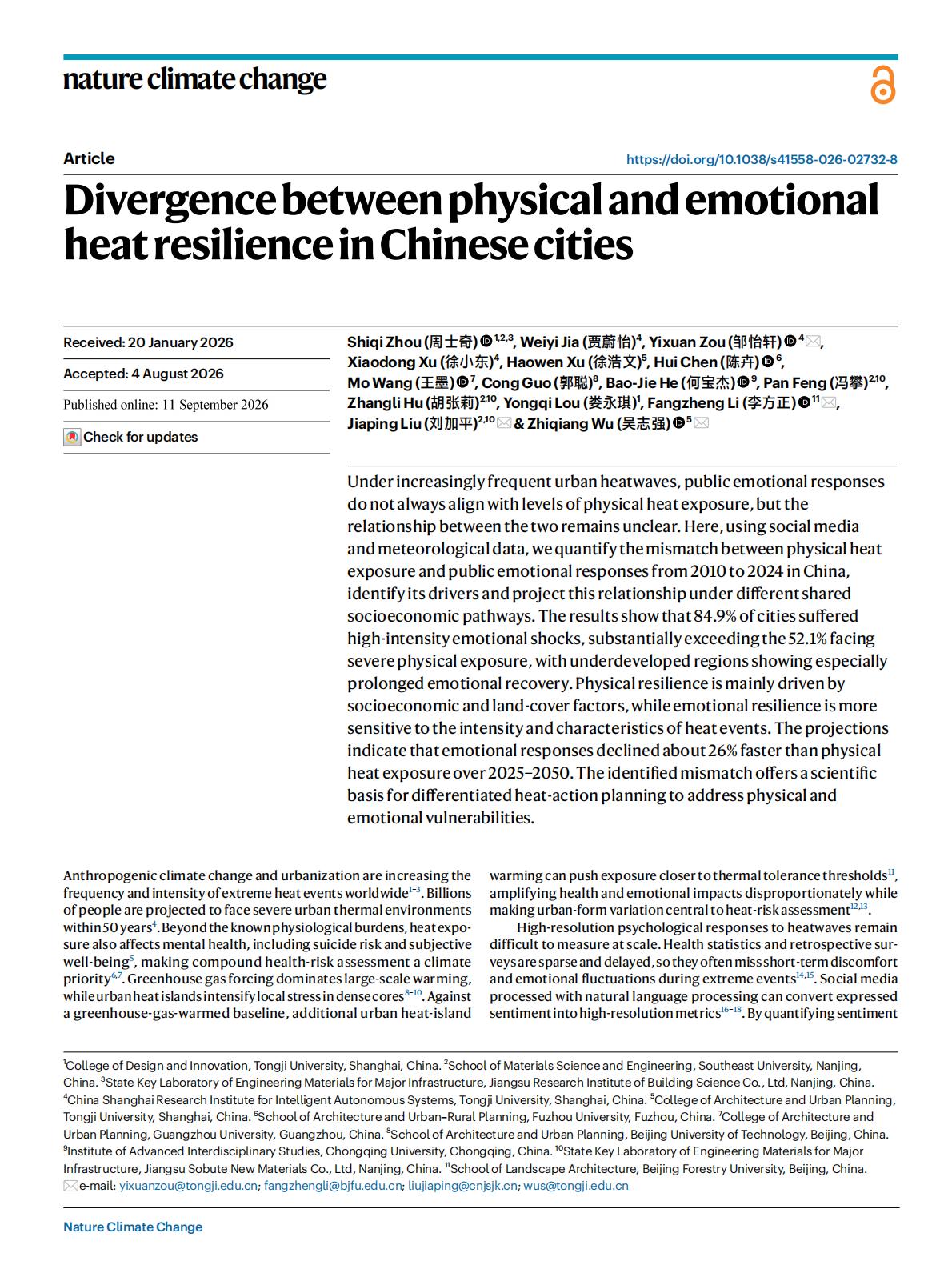
Academician Zhiqiang WU's team at Tongji University recently published a research article in Nature Climate Change entitled "Divergence between physical and emotional heat resilience in Chinese cities." The work was completed with Academician Jiaping LIU's team at Southeast University and Professor Fangzheng LI of Beijing Forestry University. Drawing on 15 years of social media and climate data from 357 cities, the team found that a city's ability to withstand extreme heat does not guarantee that its residents recover emotionally. The study brings the human dimension into urban heat risk assessment.
Most heat-risk research tracks temperature, exposure and mortality, while public emotion remains largely unmeasured. The team paired about 55 million geotagged Weibo posts with hourly climate data covering 10,863 heatwave events from 2010 to 2024. Within a common 25-day event window, they measured how sharply heat and emotion were disturbed, how long each took to recover and how much disturbance built up. These measures yielded directly comparable indices of physical and emotional heat resilience. Emotional vulnerability proved far more common. High-intensity emotional shocks hit 84.9% of cities, against 52.1% showing physical vulnerability. Economic growth has not brought faster emotional recovery, a pattern the authors call a "prosperity penalty".
Public emotion does not move in step with the heat. Emotional responses peak 2.7 days after high temperatures in coastal urbanized regions and 3.3 days after in the northwestern interior and plateau areas. Negative sentiment also lingers longer in rural areas than in cities (Fig. 1). Interpretable machine learning shows that physical resilience depends mainly on socioeconomic conditions and land cover. Emotional resilience responds more to the heatwave itself, with heat-event features accounting for 39.3% of model importance compared with 18.7% for socioeconomic factors.
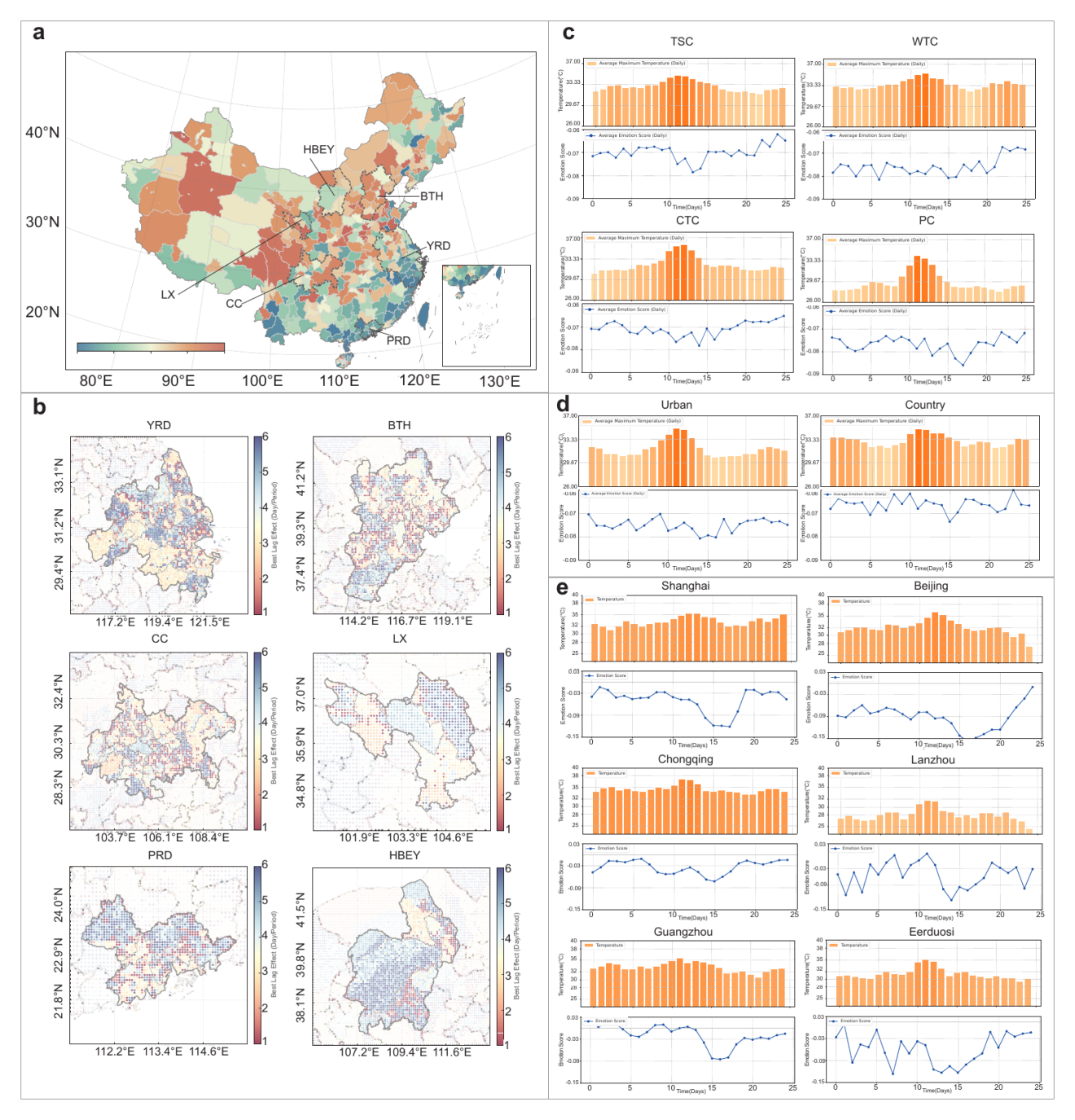
Fig. 1. Spatial heterogeneity of the lag between heat exposure and emotional response across China.
Climate projections show emotional resilience declining about 26% faster than physical resilience between 2025 and 2050. Under high emissions, recovery times lengthen by 33.5%–42.7%, more than peak intensity rises. Resilience, in other words, fails mainly because recovery stalls (Fig. 2). The authors call for heat warnings and emergency services that continue into the emotional recovery period after the heat peak, with targeted support for older adults, outdoor workers and low-income residents. Their dual resilience framework offers a new tool for forward-looking heatwave adaptation planning.
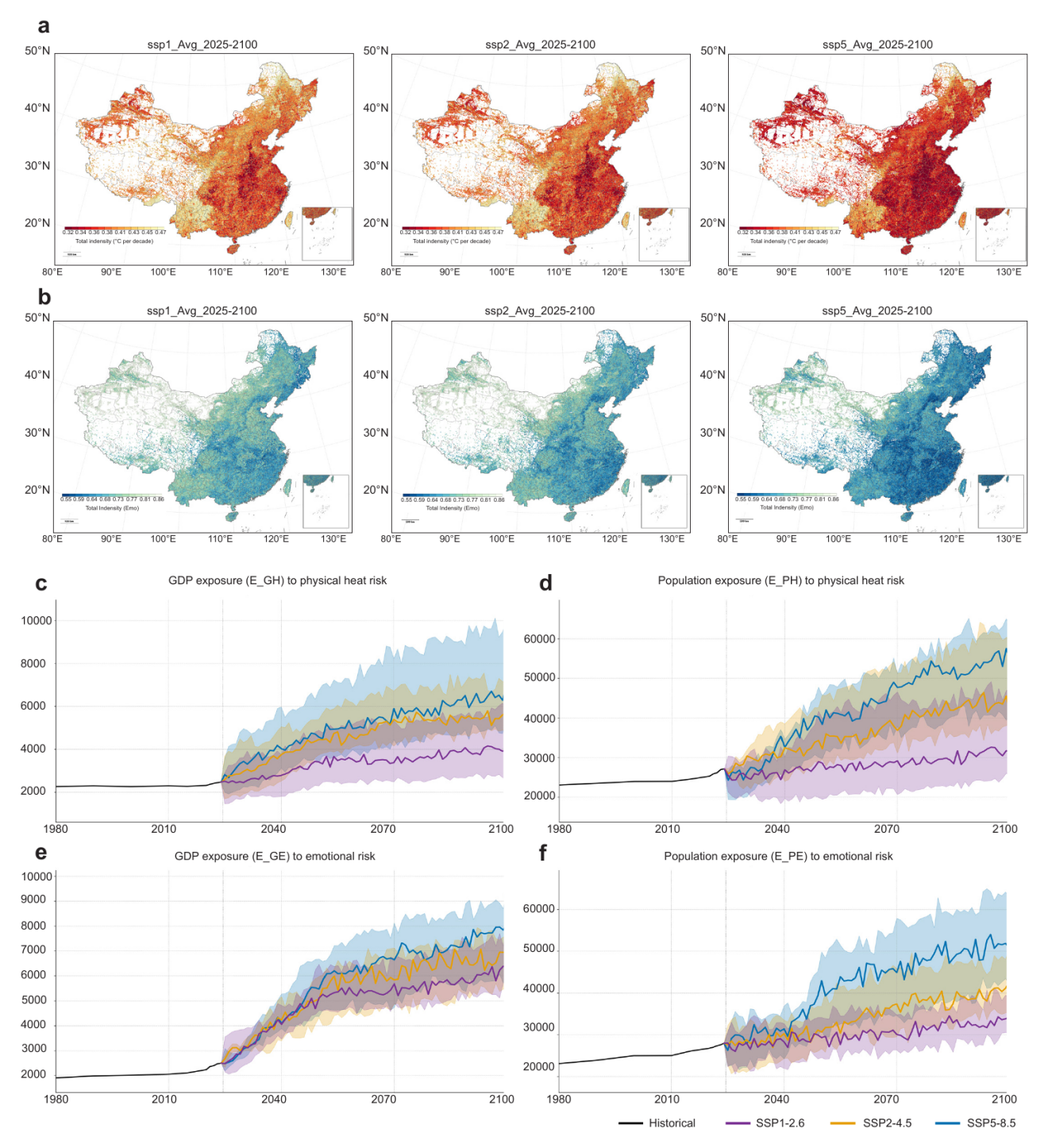
Fig. 2. Projected changes in heatwave resilience and socioeconomic exposure under three emission scenarios (SSP1-2.6, SSP2-4.5 and SSP5-8.5).
Shiqi ZHOU, Associate Research Fellow at the College of Design and Innovation, Tongji University, is the first author. Yixuan ZOU of Tongji University, Professor Fangzheng LI of Beijing Forestry University, Academician Jiaping LIU of Southeast University and Academician Zhiqiang WU are co-corresponding authors. Tongji University is the first affiliation of the paper. The research was supported by the National Natural Science Foundation of China, the Major Project of the National Social Science Fund of China and the Natural Science Foundation of Shanghai.
Article link: https://www.nature.com/articles/s41558-026-02732-8